Ask "ISI"

Joint stands rank among the most demanding formats in trade fair construction. Diverse companies, technologies, and exhibits converge within a limited space and must be staged in such a way as to create a cohesive, easily comprehensible overall impression—both in terms of content and design. Simultaneously, the challenge lies in precisely integrating the often widely varying technical requirements of the individual exhibitors into the stand’s realization, without compromising the clarity or impact of the overall presentation.
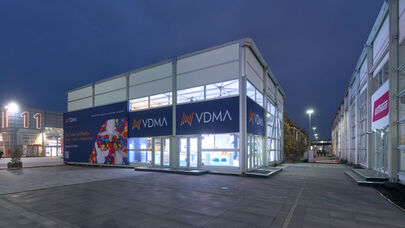
It is precisely within this dynamic interplay that projects emerge requiring something more than conventional floor planning. For several years now, the VDMA—in collaboration with ISINGERMERZ—has successfully met this challenge at IFAT Munich on behalf of its specialist associations for Waste and Recycling Technology, General Air Technology, Valves, Compressors, Compressed Air and Vacuum Technology, Pumps & Systems, and Process Engineering Machinery and Equipment; in 2026, this partnership will mark its third consecutive realization. Spanning 270 square meters, the project once again created a unified trade fair presence for these various specialist associations. This year, the central theme was textile recycling.
Consulting as a Decisive Success Factor
As is our standard practice, the project kicked off with an intensive workshop in Wiesbaden. Particularly with complex joint exhibition stands, it quickly becomes apparent whether a project is merely being organized or is truly being driven by a strategic concept. Through direct, peer-to-peer dialogue, content was prioritized, technical requirements were defined in detail, and initial spatial structures were developed.
This process is central to the final outcome: the starting point is not a pre-fabricated stand design, but rather a collaboratively developed solution that seamlessly integrates content, technology, and brand logic right from the very beginning.
Structure Over Superimposition
The central challenge lay not merely in placing a multitude of themes, exhibits, and trade associations side by side, but rather in translating them into a clear spatial and thematic structure. The objective was to provide orientation—both for visitors and for the exhibitors' communication efforts.
To achieve this, a wide variety of requirements had to be harmonized: traditional platform construction, the integration of heavy-load supports into the flooring structure, and interactive presentation surfaces. One example is the scanner wall, designed to analyze textile compositions directly at the booth. Additionally, exhibits from the participating companies were integrated in such a way that they appeared as components of an overarching system, rather than as isolated, standalone objects.
All elements were unified under the VDMA’s new corporate design and translated into a consistent spatial logic.
Technology as Part of the Staging
A defining design element consisted of suspended LED mesh screens, which visually interconnected the two central themes—recycling and water—while simultaneously reinforcing the spatial structure of the booth. In this context, technology was not employed merely as an additive element, but rather conceived as an integral component of the visitor flow.
The modular ISI design system served as the foundation for implementing this high level of thematic and technical complexity in a flexible, scalable, and precise manner—all while maintaining a clear and cohesive overall aesthetic.
Conclusion – Why This Is Crucial for Exhibitors
The VDMA’s presence at IFAT Munich serves as a prime example of what truly matters in modern exhibition stand construction: It is not the sheer quantity of exhibits that determines impact, but rather their intelligent structuring and integration into a coherent, comprehensible overall system.
Particularly for companies exhibiting at joint stands or within complex exhibition spaces, this aspect becomes a decisive success factor: Content must not merely be presented, but translated—into spatial design, structural form, and a compelling visitor experience.
This is precisely where ISINGERMERZ steps in: with an approach that seamlessly integrates consulting, design, and technical execution—transforming complex requirements into clear, functional exhibition presentations.